How to read a diamond certificate like a jeweller
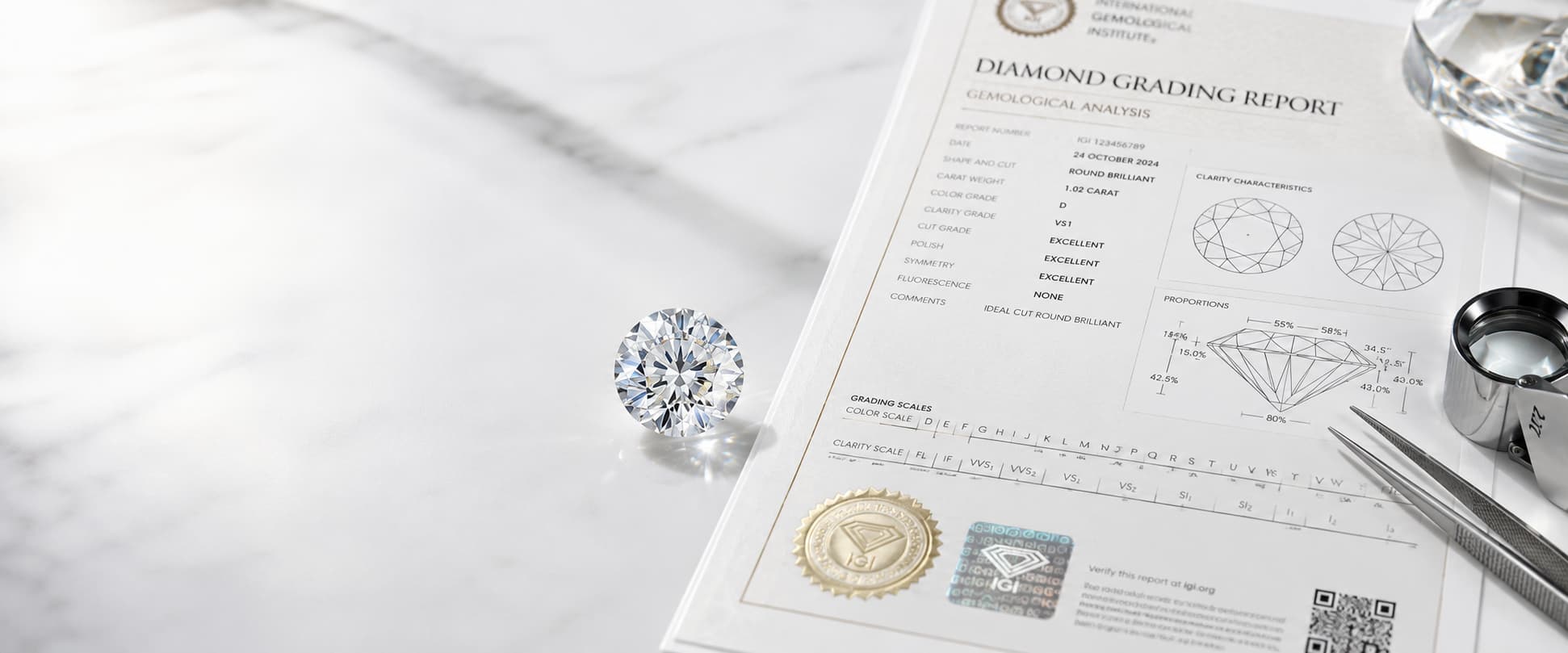
Buying any piece of diamond jewellery is a significant purchase, which is why getting it certified is a wise choice. A certificate gives you an independent, verifiable description of exactly what you own. It covers you for insurance, resale and peace of mind if you ever need to send your jewellery away for cleaning or repair. In our guide, we'll explain how to read a diamond certificate like a professional.
Different types of diamond certificate
The main laboratories issuing diamond certificates are:
GIA (Gemological Institute of America)
The most widely recognised and respected grading authority. GIA established the 4Cs grading system and sets the standard that other labs are measured against. it's considered the gold standard of diamond grading and is the strictest when it comes to grading requirements.
IGI (International Gemological Institute)
IGI is the largest grading organisation by volume, with laboratories across the globe. IGI is the most common certificate issued for lab-grown diamonds and is widely accepted and recognised, although its standards are known to be slightly less stringent than GIA.
WGI (World Gemological Institute)
WGI covers grading reports for diamonds and coloured gemstones, and is more commonly used for stones at a lower price point.
Shining Diamonds certificate
A Shining Diamonds certificate is graded by GIA-qualified professionals who are independent, not in-house employees. They apply the same standards of grading as GIA without the high cost.
How to read a diamond certificate
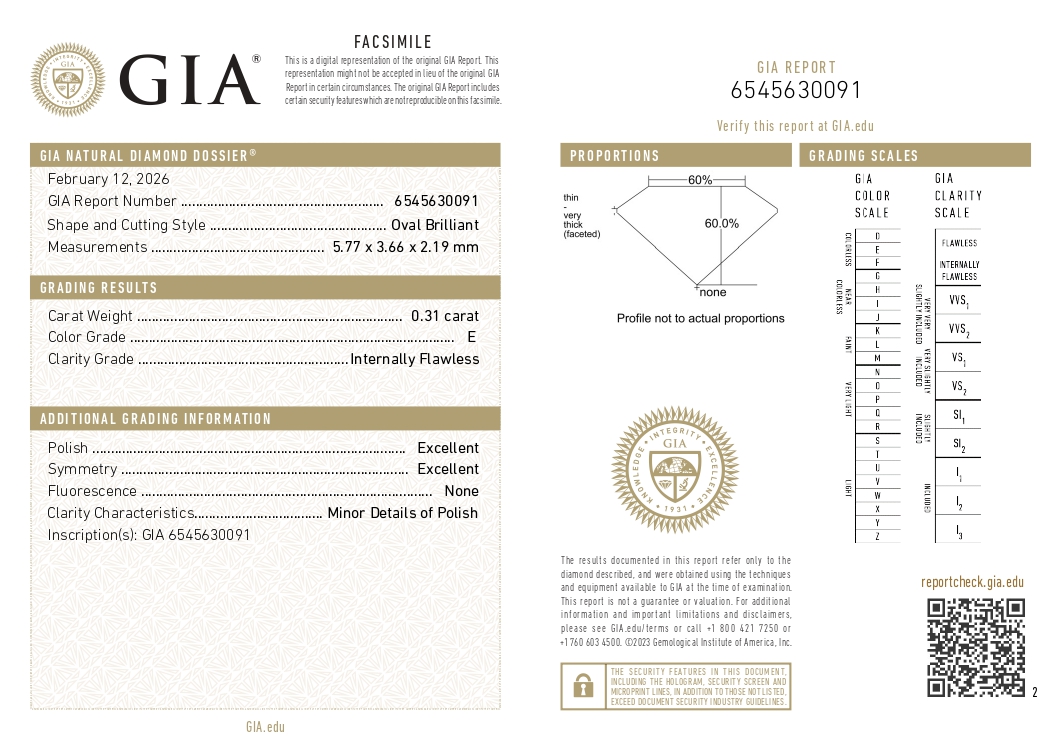
Using GIA as the gold standard of diamond certificates, we have listed the elements you'll find on a diamond certificate and what they mean. Since 2020, GIA has issued digital reports that can be downloaded as a PDF.
Laboratory name and logo
The lab name confirms who issued the report, establishing the grading standard applied to the stone. A GIA certificate, for example, applies stricter grading criteria.
Report number
The report number is the unique identifier for the certificate. If you choose a GIA or IGI certificate, this number will also be lasered into the girdle of the stone, matching the physical diamond to its paperwork.
Report date
The report date shows when the stone was graded. This is only relevant if a stone has been altered in any way since the certificate was issued.
Lab grown or natural diamond
The certificate will state whether the diamond is lab-grown, and if so, whether it was created via Chemical Vapour Deposition (CVD) or High Pressure, High Temperature (HPHT) methods.
Shape
The shape and cut describe the outline and facet arrangement, for example a Round Brilliant, a Princess cut or an Emerald cut. This affects how light behaves within the stone.
Measurements
The physical dimensions of the stone are given in millimetres. For round brilliant diamonds, this is listed as minimum diameter x maximum diameter x depth. For fancy shapes, it's listed as length x width x depth. Measurements let you verify the stone fits well in its setting and confirm how the carat weight is distributed.
Carat weight
The carat weight is the mass of the stone, recorded to two decimal places. Weight and visual size are similar, but they aren’t the same thing. Cut proportions affect how large a stone appears at any given carat weight.
Colour grade
The colour grade is assessed on a scale from colourless to light yellow or brown (D to Z). Stones are measured by comparing them against master stones under specific lighting conditions. D to F are colourless, G to J are near colourless, and K onwards are tinted yellow or brown.
Clarity grade
Assessed under 10x magnification. The scale runs from Flawless (FL) at the top, through to Internally Flawless (IF), Very Very Slightly Included (VVS1, VVS2), Very Slightly Included (VS1, VS2), Slightly Included (SI1, SI2), and Included (I1, I2, I3) at the bottom.
Clarity plot
A diagram of the stone, shown from the top (crown) and side profile, with inclusions and blemishes marked using standardised symbols. Red marks indicate internal inclusions, while green marks indicate surface blemishes. A key identifies each inclusion type.
Cut grade
The cut grade applies only to round brilliant diamonds on a GIA report. It ranges from Excellent, Very Good, Good, Fair and Poor. It reflects how well the stone's proportions, symmetry and polish combine to handle light.
Polish
Polish is graded in the same way as cut, ranging from Excellent to Poor. It describes the quality of each facet surface. Poorly polished diamonds scatter light as it hits the surface, reducing the fire and brilliance emitted from the stone.
Symmetry
Symmetry is also graded from Excellent to Poor. It describes how the facets align and mirror one another. A diamond with poor symmetry misdirects the light return.
Fluorescence
Fluorescence describes the stone's response to ultraviolet light. It's graded None, Faint, Medium, Strong or Very Strong, with the colour of the fluorescence also noted on the certificate. Strong fluorescence can cause a hazy appearance in some lighting conditions.
Proportion diagram
A cross-section diagram of the stone showing table percentage, depth percentage, crown angle, pavilion angle, girdle thickness and culet size. These numbers determine how light enters the diamond, reflects internally and exits. For round brilliant diamonds, the proportion diagram confirms whether the stone sits within the ranges associated with maximum brilliance.
For a round brilliant diamond, these are the ranges jewellers and gemologists use as a guide for maximum brilliance:
-
Table percentage: 54%–60%. The table is the flat top facet. If it's too large the stone loses fire; if it's too small, the fire loses brightness.
-
Depth percentage: 59%–62.5%. Total depth as a percentage of average girdle diameter. Stones that are too deep or too shallow allow light to leak through the pavilion rather than reflecting it back to the eye.
-
Crown angle: 34–35 degrees. The angle of the upper facets relative to the girdle. Crown angle works in combination with pavilion angle; the two need to complement each other to maximise light return and fire.
-
Girdle thickness: Thin to Slightly Thick. A very thin girdle risks chipping, whilst a thick one adds carat weight without any benefit to the diamond's appearance.
-
Culet: None or Pointed. A large culet appears as a dark circle when viewed straight down through the table. Modern cutting methods can eliminate it entirely.
Security features
Some certificates feature a hologram, microprint lines and a security screen visible under UV light, confirming the certificate is genuine.
Why buy a diamond with a certificate?
If you buy a certified diamond, you can confirm that the stone matches its description and value. A certificate supports insurance by providing the documented specification needed to underwrite a stone accurately, and makes it easier to make a claim if the diamond is lost or stolen. If resale value, or passing your jewellery down as a family heirloom, is important to you, a certified diamond holds its value better and signals trust to any potential buyer.
How can Shining Diamonds help?
Here at Shining Diamonds, we offer our own certificates graded by qualified professionals, at a lower cost than the main diamond labs. You can easily select your preferred certificate on any of our made to order items. Or if you want more help and advice, simply contact us or drop into one of our stores to speak to a professional.