How are diamonds cut?
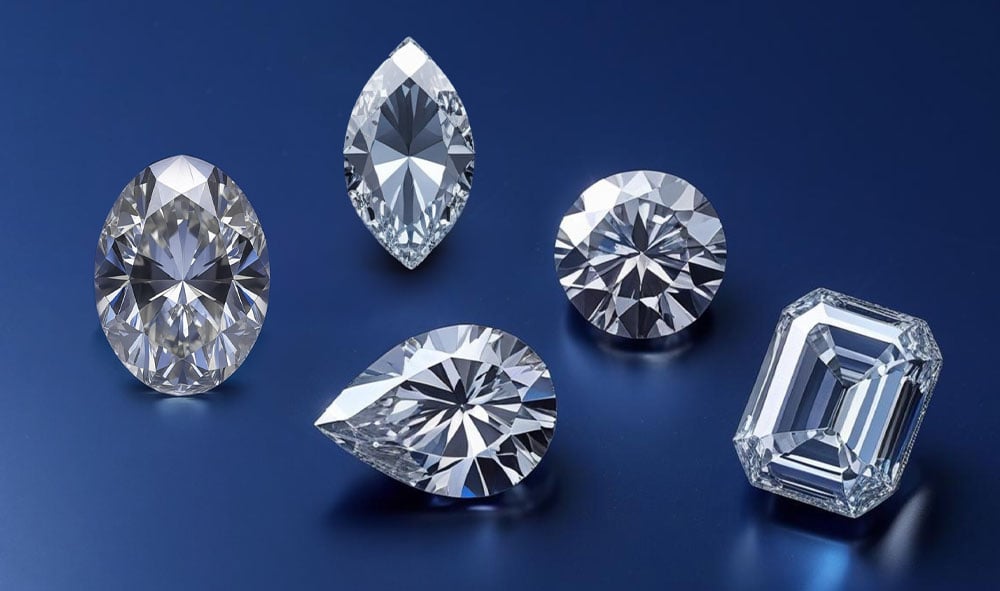
Diamond cutting is the process of transforming a rough diamond into the different diamond shapes we see on the market today. However there is so much more to a diamond’s cut than the shape alone. We’ll take you through each stage of how a diamond is cut from the rough stone to maximise its brilliance and sparkle.
The 5 Steps to Cutting a Diamond
1. Planning: Mapping the Rough Diamond
Before any cutting begins, gemmologists study the rough diamond under microscopes and use 3D imaging to locate internal inclusions and natural grain lines. This planning phase allows diamond cutters to identify the ideal orientation and shape to maximise carat weight and clarity, laying the foundation for how to cut a diamond efficiently and beautifully.
2. Cleaving and Sawing: Dividing the Diamond into two Diamonds
Rough diamonds are often too large or irregularly shaped to be cut into one diamond alone. They usually take the form of an octahedral, cubic and triangular shape. The first step is to see where the rough diamond has a cleavage, this is a weaker point in the diamond’s structure where you can split it into two diamonds, the process is called splitting or cleaving. Due to the hardness of the stone, experts must use diamond-impregnated blades which means they have diamonds embedded in the blade to cut through the diamond; however lasers are often used today for this initial process which will split a diamond quicker and with greater accuracy than more traditional methods.
3. Bruting: Shaping the Outline
Bruting is the process of starting to shape the rough diamond by creating multiple surfaces whilst establishing the diamond's girdle. The bruting process involves using another diamond against the rough on a diamond wheel as they push against each other to wear down excess carat weight and create the basic diamond profile before facets are added.
4. Pavilion Faceting: Shaping the Lower Half
The upper facets include the table and star facets which are polished to refract light back to the viewer’s eye. The next stage is to shape the facets on the sixteen lower girdle facets. Throughout this process, each facet has to align exactly on the index wheel; any deviation of even half a degree can cause light to leak out of the pavilion rather than reflecting upward, dramatically reducing the diamond’s brilliance and fire.
5. Crown Faceting: Perfecting the Upper Half
After the pavilion is complete, the cutter turns the diamond over to begin crown faceting. This stage creates the facets that surround the table facet (the large, flat central top facet). The surrounding facets are called star, bezel and upper girdle facets. Each crown facet is cut and polished at carefully calculated angles to work in harmony with the pavilion facets. By balancing pavilion and crown angles, cutters ensure the diamond achieves its highest cut grade possible whilst maintaining the largest carat weight from the rough stone.
6. Polishing: Final Refinement
After faceting, each surface is polished on rotating laps charged with diamond powder. This last step removes blemishes and ensures a sparkly and reflective finish on every facet. The resulting brilliance and sparkle is a testament to the cutter’s skill and the stone’s cut grade. These grades range from Poor to Excellent on the cut and two sub grades known as the polish and symmetry.
Why Cut Quality Matters
The cut is the only one of the Four Cs created purely by human craftsmanship rather than nature. The higher cut grades such as Ideal or Excellent cut is the best way to get maximum brilliance (white, bright, light), fire (colour flashes) and scintillation (sparkle patterns). According to GIA, the cut impacts a diamond’s beauty more than the carat weight.
How to cut a diamond to maximise sparkle?
GIA certificates offer the exact proportions of your diamond, to explain its cut grade referring to the diamond not being cut too deep or too shallow; this includes measurements of the diamond’s table, depth, girdle thickness and pavilion angles to access the diamond's final cut grade.
Diamond cutting is where science meets artistry. From the careful planning of each facet to the final polish, every decision shapes the gem’s beauty. Next time you admire a beautiful piece of diamond jewellery, you will appreciate the precision and craftsmanship behind its perfect cut, and understand why every diamond is different and unique. At Shining Diamonds, we have a wide range of diamonds available for you to choose from. Shop now or book an appointment to view our precious diamonds in-store.